Hello, my friend.
Pull up a chair.
I've been thinking a lot lately about fantasy worlds. Mine and others'. More specifically, why some of them feel alive, some that we think about long after we've closed the book, while others are forgotten almost as soon as we've finished the chapter.
When I first started writing WoodBound, I thought that building a fantasy world meant creating maps, naming places, inventing languages and deciding where mountains, rivers and kingdoms would sit. Basically, everyone had to be the new Tolkien before publishing a page.
In hindsight, I don't think any of those things were what made Elarion or the Yggdrasil Forest feel real to me.
They became real when someone started living their life in them.
It's one thing to say that Yggdrasil stretches for miles bathed in a canopy of endless green. Those are just words. They paint a picture, but they don't invite you in.
It became real when Endrin walked beneath those branches, brushing leaves aside with the back of his hand, feeling the rough bark of the trees beneath his fingertips and breathing in the smell of fresh sap carried on the breeze. The forest stopped being somewhere to describe and became somewhere to experience.
The same happened when the Skarn family returned home after so long. Crookedholm Cottage didn't feel familiar because I'd described every chair, cupboard and every speck of dust. It felt familiar because it felt lived in.
A home isn't four walls. It's memories. It's comfort. It's the feeling of walking through the front door and knowing you're where you belong.
That's the point where a world begins to breathe.
Something else I've noticed over the years is that a lot of fantasy worlds don't necessarily fail because they're poorly imagined or badly described.
Sometimes they just don't give themselves enough room to breathe.
People often say, "Take your time."
To me, that doesn't mean slowing the story down. It means spending the right amount of time on the moments that matter.
If every page is packed with paragraphs describing every tree, every building and every blade of grass, eventually the reader switches off and simply reads words.
I'd rather someone remembered one particular tree because something important happened beneath it than forget an entire forest because I described every inch of it.
The details that stick in our memories are usually the ones attached to a feeling.
If someone asked me where to begin building a fantasy world, I probably wouldn't tell them to draw a map...
I'd ask them to close their eyes.
Imagine someone standing somewhere in that world. It doesn't even have to be your main character. It could just be someone buying bread, sitting beside a river or walking home after a long day.
Now ask yourself:
- What do they see?
- What do they hear?
- What do they smell?
- What do they touch?
Once you've answered those questions, you've already started building your world.
Then comes the fun bit:
Does magic exist in this world?
Because if the answer is yes, that changes everything.
Magic isn't just another fun element to add. It changes how people live in your world. It changes what they fear. It changes religion, medicine, travel, work and even the way people would interact with each other.
The world should grow naturally from those questions rather than simply decorating itself with magic afterwards.
Interestingly enough, I have a cheek to talk.
I broke one of my own rules while creating Elarion.
Normally, I'd tell people not to begin with a map.
This time, I did... kind of.
Looking back, I don't regret a thing.
I drew Elarion. It felt like I was drawing a dream.
That sketch gave me a feeling before it gave me directions.
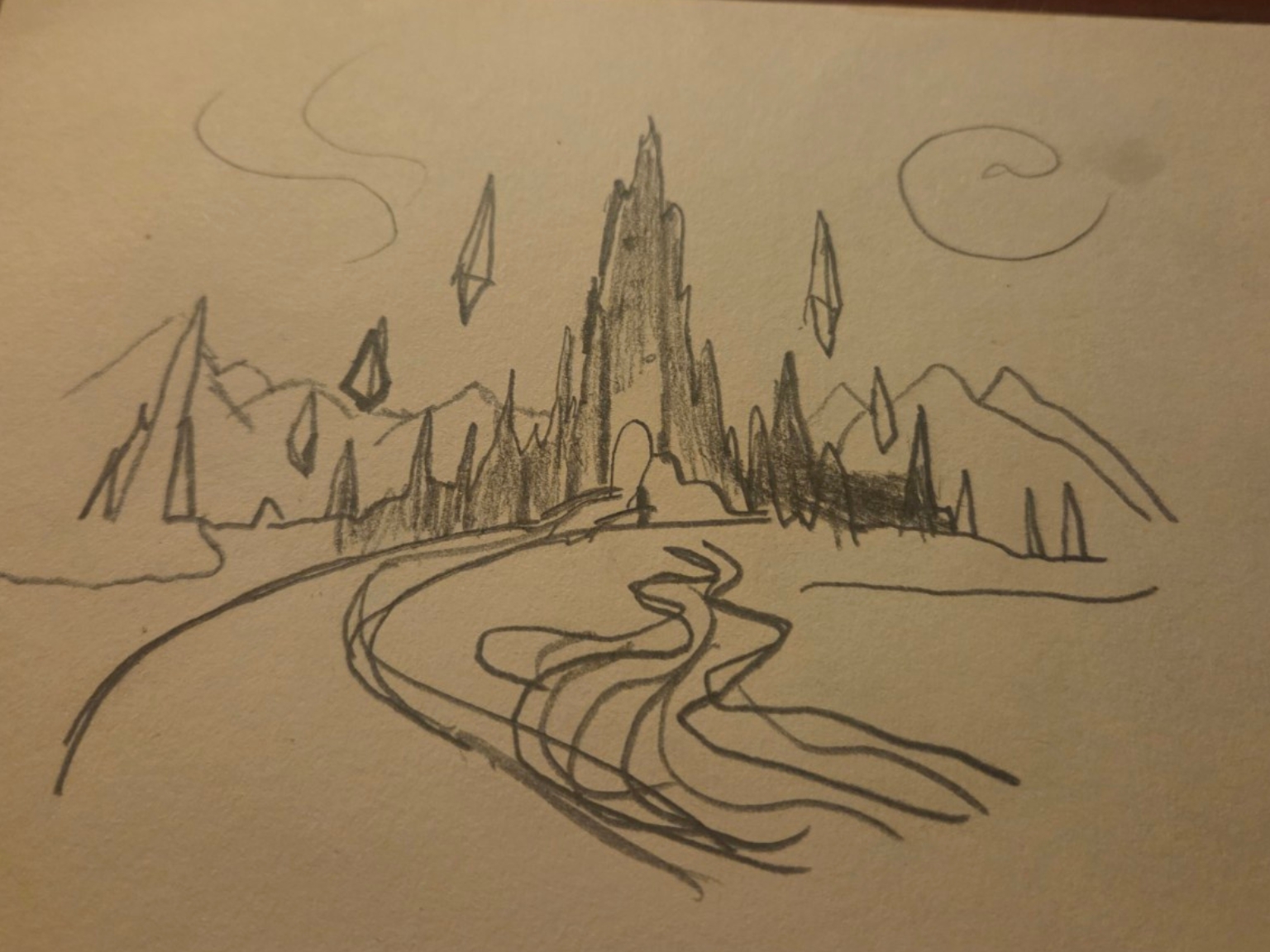
It helped me understand the atmosphere of Elarion long before I wrote a single word about it. From there, everything else slowly found its place.
I suppose that's one of the things I've learned about creativity over the years. There are very few absolute rules. Sometimes your own process surprises you.
If there's one thing I'd hope you take away from this conversation, it's this.
Don't worry about making your world bigger, fancier or described to within an inch of its life.
Worry about whether or not someone could actually imagine themselves living in it.
Before you head off, can I ask you one small favour?
If you see a piece of paper, don't leave it blank. Obviously, make sure it's your paper. Make sure you aren't vandalising someone else's property.
If this conversation sparked an idea, write it down.
It doesn't have to be a chapter.
It doesn't have to be good.
Write a sentence.
Sketch a creature.
Jot down a place name.
Capture whatever came into your mind while you were reading.
Ideas have an awful habit of running off if we tell ourselves we'll remember them later.
Who knows?
That one little note might be the first step into a world only you could create.
Until next time,
L. T. Stewart